A closer look at BCBST’s financials in a year of record-high claims
Where member premiums go and why it matters
At BlueCross BlueShield of Tennessee (BCBST), we believe members deserve to know exactly how their health insurance dollars are spent. Here’s a breakdown of our financials from 2024, showing our commitment to responsible stewardship and member care.
Breaking Down the 2024 Premium Dollar
When a member or employer pays for health coverage, that money doesn’t just sit in a bank account. It goes to work immediately to fund care and support operations.
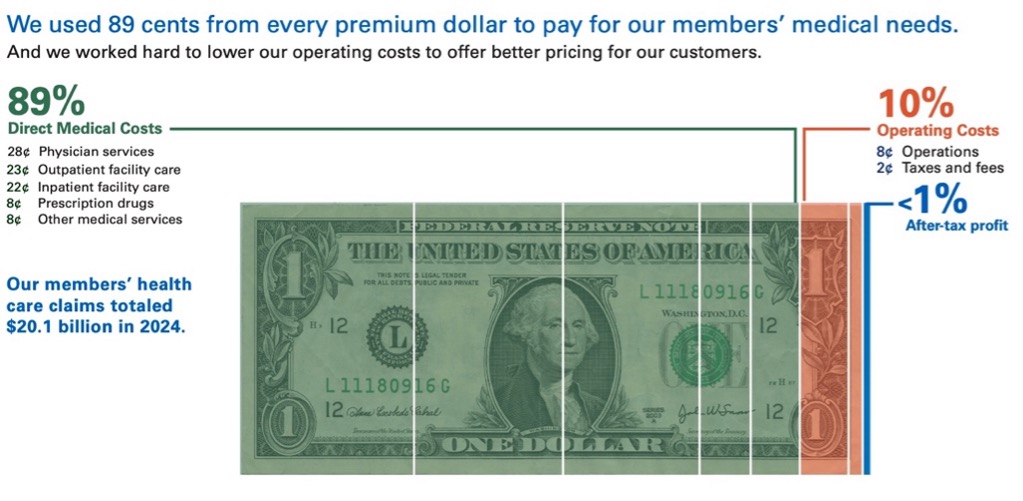
Here’s how a single premium dollar was spent in 2024:
- 89¢ — Medical Care for Members
This is the largest portion by far. It covers:
-
- Doctor visits and specialist care
- Hospital stays and surgeries
- Prescription medications
- Lab tests, imaging, and other treatments
Whether it’s a routine checkup or a life-saving procedure, this is the core of our business: helping members get the care they need.
- 10¢ — Administrative Costs
These are the costs of running our business efficiently:
-
- Paying employees
- Maintaining facilities
- Investing in technology
- Processing claims and customer service
- Complying with regulations
- Paying taxes and fees
We’re proud to keep administrative costs low at just 10% of revenue.
- 1¢ — After-tax profit
BlueCross earned just 1¢ in after-tax profit for every premium dollar in 2024. That single cent helps us:
- Reinforce our financial stability
- Maintain reserves to protect members
$20 billion in claims, $56 million in operating profit
In 2024, BCBST paid out a staggering $20.1 billion in claims for medical care, a 13% increase over the previous year, even as membership slightly declined.
Despite this massive outlay, BCBST’s operating profit was just $56 million. To put that in perspective, that’s less than 0.3% of total claims paid.
The company also earned $325 million through returns on the investments in our reserve fund, bringing total after-tax net income to $381 million. Investment returns have accounted for about half of BCBST’s net income over the past five years.
Administrative costs and taxes
In 2024, our administrative costs, including employee salaries, technology, customer service, and compliance, accounted for 10% of revenue. BCBST also paid $538 million in taxes to support essential programs and services across Tennessee. That’s 41% more than the company earned in after-tax profit.
We’ve always believed it’s our responsibility to be good stewards of premium dollars, which includes keeping our operating costs low. Since the second half of 2024, we’ve been making both short-term and long-term changes to our administrative spending so we can protect affordability for our customers.
Some of these decisions included:
- restricting non-essential travel
- being more cautious about which vacant jobs to backfill
- taking a fresh look at vendors and contracts
- reducing corporate sponsorships
The company also earned $325 million through returns on the investments in our reserve fund, bringing total after-tax net income to $381 million. Investment returns have accounted for about half of BCBST’s net income over the past five years.
What happens to profits?
Unlike for-profit insurers, BCBST is a taxpaying not-for-profit. There are no shareholders. The company’s net income margin was just 1.7%, well below the double-digit margins seen in other parts of the health industry, such as pharmaceutical companies. Those earnings go into our reserves to maintain financial stability for the people we serve.
Reserves: members’ safety net
BCBST holds enough money in our reserves to cover about four months of claims. Reserves are not excess profits. Think of it like a family’s emergency fund. It ensures we can pay claims even during economic downturns, natural disasters, or public health crises. Our reserves are a responsible stability fund that protects members.
While reserves are sometimes publicly suggested as a quick fix for any issue, using this safety net in that way would be shortsighted and undermine our ability to protect members’ long-term well-being. We remain committed to maintaining healthy reserves to ensure uninterrupted care, even in the face of catastrophic events.
Why it matters
The vast majority of our 2024 profit came from investments, not operations. And over the past five years, investment income has made up about 53% of our total profit.
Our earnings help us:
- Keep premiums as low as possible
- Invest in better services and technology
- Build reserves to protect members during uncertain times
View our 2024 Financial Stewardship infographic here.
How we give back to the community
We often receive questions about if premium dollars are used to fund the company’s charitable efforts. The BlueCross BlueShield of Tennessee Foundation’s funding is separate from corporate operations and must be used to benefit Tennessee communities.
The company provided seed funding for the Foundation nearly 15 years ago. Today, the BlueCross Foundation operates like an endowment, and the company has not contributed money since 2014. Our signature effort, the BlueCross Healthy Place program, is supported through the Foundation, and no premium dollars are used to fund BlueCross Healthy Place projects.